
What Tracking Training Develops
Dog tracking training gives a dog a defined scent trail to follow with its nose. The work depends on information present along the laid track, not on visual cues or assumptions about who made it. In IGP, tracking is one part of a sport that also includes obedience and protection. A clear grasp of the task helps you distinguish following a track from other kinds of scent work.
Scent work
On a laid track, the dog follows scent along the route left by the tracklayer, using its nose to stay with that line rather than moving by sight alone. The task is sequential: the dog samples scent information at one point and continues along the route using the information available farther ahead. Teaching dogs to follow human scent means teaching them to work the track itself, not simply to approach the person who laid it.
A track can carry scent information associated with footsteps and changes where those steps meet the ground. The dog’s job is to follow the available scent along the path; the handler should not assume that this reveals a person’s identity. Likewise, following a track does not establish that the dog can identify an object that has no scent information connecting it to the route. The track defines what the dog can work.
This makes scent work a task of staying with a continuous trail rather than searching generally for a person or object. A dog that follows the laid route is responding to scent along that route; it is not necessarily recognizing who created it or what may be at its end. Keep that distinction clear when describing the dog’s work: the observable result is track following, based on scent information available on the ground.
Tracking in IGP
IGP tracking is the sport’s track-following phase, alongside obedience and protection. It gives the dog a specific scent-based task within a broader performance that also requires different forms of work. IGP tracking foundations therefore develop purposeful movement along a laid route, rather than treating scent work as an open-ended search for anything the dog might detect.
Sport tracking centers on following the track defined for the exercise. That differs from activities built around locating a concealed item in a search area: in IGP, the route itself is the task. Other scent activities may use different search patterns or goals, so results from one activity should not be treated as proof that a dog can perform another. In either case, claims about what a dog identifies should stay within the scent information available to it.
Within IGP, track work contributes a distinct measure of the dog’s ability to stay with the assigned scent path while working under the sport’s rules. It complements obedience and protection rather than replacing either one. For a clear training objective, assess whether the dog follows the laid route; do not infer that the dog recognizes the tracklayer or an object beyond the scent information on the track.
Prepare the Training Setup
A well-chosen training area makes it easier to see whether a dog is following human scent or reacting to the surroundings. For IGP tracking foundations, control the setting before changing the track or the reward. Check the ground, weather, available space, and nearby activity, since each can influence scent availability and concentration. A consistent setup gives you clearer observations from one session to the next.
A suitable area
Choose a location where the dog can work without people or animals crossing the track, and where you can watch the nose, pace, and line of travel. These checks help distinguish the dog’s tracking behavior from reactions to the setting.
- Space without interruption: Select an open patch with room for the intended track and a clear buffer from paths, gates, parked vehicles, and routine foot traffic.
- Manageable distractions: Start away from feeding areas, play zones, livestock, and busy entrances; nearby movement should be limited enough that you can identify what draws the dog’s attention.
- Safe footing: Walk the route first and check for holes, slick mud, sharp debris, thorny plants, or steep slopes that could make the dog alter its gait.
- Observable surface: Choose ground where you can see vegetation, soil disturbance, and the dog’s foot placement; short grass or open soil may make changes easier to notice.
- Clear boundaries: Avoid narrow strips between fences or obstacles, where the handler has little room to follow and the dog may be forced to turn abruptly.
- Handler visibility: Favor a route with an unobstructed view from a safe following position, so head movement, pauses, and changes of direction remain visible.
A controlled location makes dog tracking training easier to assess: when the dog changes pace or attention, you can compare that behavior with visible ground and nearby activity. Keep the area simple until you can read those details reliably.
Track conditions
Surface, weather, and nearby activity can change how human scent is distributed and how readily a dog stays focused. Before altering the task, note what is present along the route and what the dog does at those points.
| Condition | Examples | Possible effect | What to observe first |
|---|---|---|---|
| Surface | Short grass, taller grass, bare soil, or compact gravel | Vegetation and exposed ground hold and release scent differently; rough or shifting ground can also affect footing and pace. | Look for changes in vegetation, soil, and the dog’s nose position or stride where the surface changes. |
| Ground moisture | Dry soil, damp soil after light rain, or wet grass | Moisture can alter scent conditions and may soften the ground, making footstep details more or less visible. | Check whether the dog’s focus changes at damp patches, and whether the surface shows clear disturbance. |
| Wind | Calm air, a steady breeze, or a crosswind | Moving air can carry scent away from the footstep line, while a crosswind may affect where the dog samples it. | Note wind direction against the route and watch for lateral head movement or a change in line. |
| Precipitation and temperature | Light rain, drying ground, cool conditions, or warm sun | Rain and drying can change surface moisture; warmth may make the dog less comfortable or less attentive. | Check for changing ground texture, direct sun, panting, or reduced concentration before interpreting a tracking change. |
| Distractions | Passing walkers, wildlife, livestock, or nearby food | Fresh activity or competing odors can draw attention away from the laid track. | Identify the location and timing of each distraction, then compare it with any pause, head turn, or departure from the line. |
Record the conditions alongside the dog’s behavior rather than changing several factors at once. The most useful setup is a safe, observable surface with manageable activity, because it makes the next adjustment easier to judge.
Build a Basic Tracking Session
A useful dog tracking training session starts with one uncomplicated task the dog can complete. Keep the handler’s actions consistent so the dog can connect the track with purposeful nose work. Watch what the dog does before deciding whether to add difficulty; confident progress matters more than completing a preset pattern. A repeatable approach helps build calm, accurate work without rushing progress.
Introduce the task
Build the first IGP tracking foundations through a clear sequence, changing only what the dog is ready to handle. Each step should clarify the purpose of the exercise.
- Choose a manageable setup with little competing activity, so the dog can attend to the handler’s track rather than searching broadly for another task.
- Present the track clearly, using a deliberate starting point and consistent handling, so the dog can identify where the scent-following exercise begins.
- Give the dog room to work at the track without constant steering; this lets the dog use its nose, with progress following its own search.
- Observe the response throughout the attempt, noting whether the dog stays engaged and follows the intended path before deciding what to change next.
- Adjust one element of difficulty at a time after a successful effort, preserving familiar parts of the exercise while introducing a manageable new challenge.
Following human scent can be developed through steady, independent work rather than repeated prompting. The handler can keep the exercise clear by maintaining a clear start and allowing the dog to complete its work.
When the dog cannot settle into the task, return to a simpler presentation instead of adding more track complexity. That gives the next attempt a clearer starting point and keeps the dog’s effort directed toward the scent trail.
Observe pace and focus
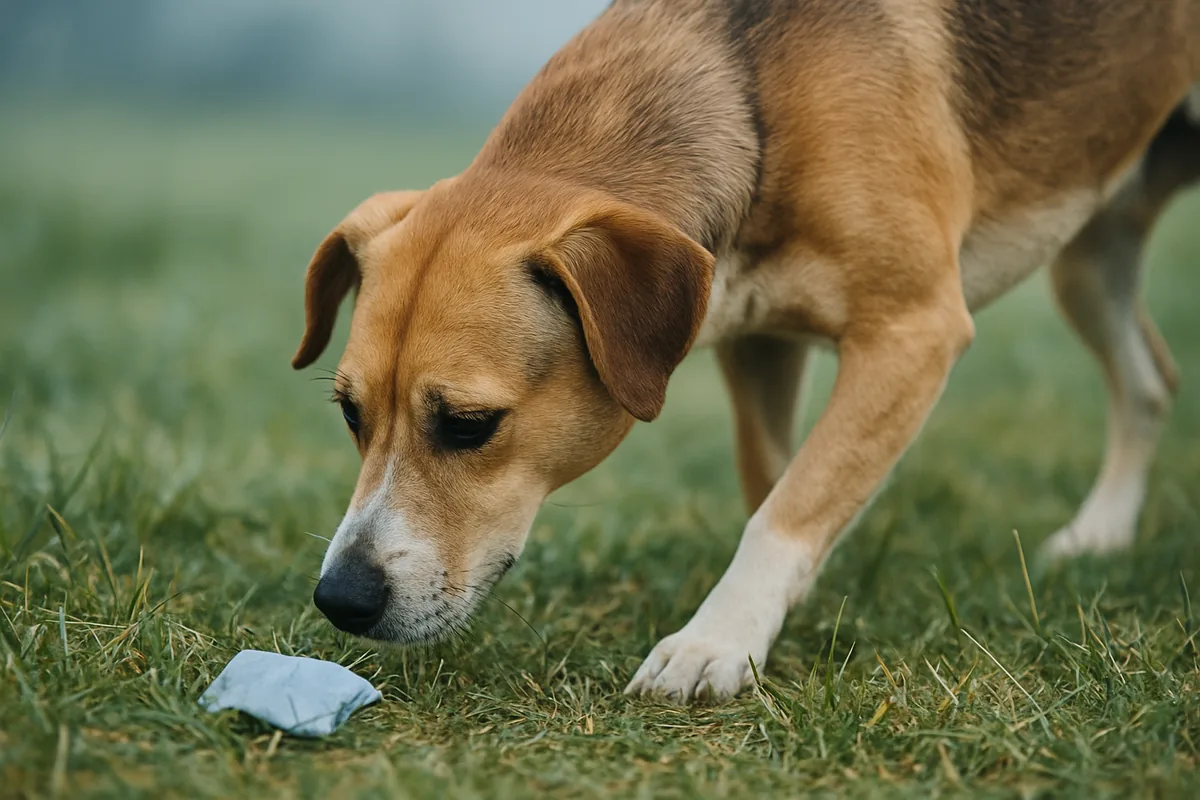
Assess the dog’s work by watching how its nose, movement, and attention function together. A dog engaged with the track generally keeps its nose close to the ground, moves with deliberate steps, and continues checking the scent path rather than repeatedly looking to the handler for direction. The pace need not be uniformly slow; it should remain controlled enough for the dog to investigate and correct its line.
Notice whether attention returns to the track after a brief interruption, and whether the dog follows the scent through small changes in its availability. Persistent searching in the same area, a lifted nose, or frequent glances away can indicate that the task has become harder to read. These signs are more informative than speed alone: forward movement is useful only when it remains connected to the track.
For tracking training for dogs, make the next attempt simpler when nose use becomes inconsistent or the dog repeatedly loses the scent path. Preserve familiar elements and reduce a single challenge, such as how much new ground the dog must interpret. If the dog stays attentive and follows the track with a controlled pace, keep the exercise similar or introduce one modest change. Do not increase several demands at once, because that makes it difficult to tell which change affected performance.
Compare each attempt with the dog’s own recent work rather than imposing a numerical pace or score. The practical guide is simple: keep the task steady while the dog remains connected to the scent, and simplify when attention or nose use breaks down.
Articles and Indications
Articles and indications give the dog a defined endpoint within IGP tracking work: locate an object on the laid track and communicate that find in a recognizable way. The article is a target within the exercise, while the indication is the dog’s trained response when it reaches that target. These are related but distinct parts of the work; locating an article does not establish that a dog can identify unrelated objects or people. Clear observation helps the handler recognize when the dog has found the specific track article.
What an article is
In IGP tracking, a scent article is a discrete object deliberately placed on the track by the tracklayer. It is part of the exercise, not simply an item lying nearby: the dog is expected to locate the object at its position along the track. The article carries scent from handling and contact with the ground, but its role is defined by the tracking task. Its material and dimensions are governed by the applicable rules, so handlers should use the prescribed type for the training or trial context rather than assume every object is suitable.
Tracking articles for IGP provide a specific point of recognition within a track. The dog’s response concerns that object in that exercise; it is not a general test of whether the dog can identify a person, distinguish household belongings, or recognize every object with a similar smell. A dog may treat the article as a trained target through its placement and the consequences associated with finding it, while still needing separate work to identify other objects or people. Keeping that distinction clear prevents claims about scent recognition from going beyond what the tracking exercise demonstrates.
Clear indication
An indication is a trained, recognizable behavior that tells the handler the dog has located an article. Depending on the training approach, the dog may stop and adopt a defined position, such as lying down, or show another established response. The essential feature is that the behavior is distinct enough to identify at the article, rather than being an ordinary pause while following the track. In dog tracking training, a consistent response makes it easier to tell when the dog has found the object and gives the handler a clear moment to acknowledge the find.
Handlers should watch the dog’s position in relation to the article, the timing of the response, and whether the behavior is recognizable on repeated finds. A response several steps beyond the object, or one that changes unpredictably from article to article, is harder to interpret than a clear, repeatable behavior at the item. Avoid assuming that one indication style applies to every trial: exact expectations, including the required response and handling, depend on the current rules for the event. For reliable work, choose one clear indication and reinforce it consistently at the article.
Common Setbacks and Adjustments
Tracking performance can vary from one session to the next, even when a dog knows the routine. A distracted start, a fast pace, or repeated departures from the line can reflect a mismatch between the task and the conditions that day. Look for specific changes in the setup rather than adding more pressure or repeating the same attempt unchanged. Small, controlled adjustments make it easier to identify what helps the dog work steadily.
Loss of focus
A dog that pauses often, turns toward nearby movement, or repeatedly lifts its nose may be finding the session difficult to maintain. Competing distractions such as people crossing the field, nearby dogs, or a vehicle passing can interrupt concentration, especially when those distractions are closer than the track. Conditions can also make scent information harder to follow: gusting wind, dry ground, or a surface that differs sharply from recent practice may change how the dog works. These are possible session-related causes, not proof that the dog has lost its ability.
Review what changed before adjusting the dog’s behavior. Compare the location, surface, weather, track length, and number of turns with a recent session in which the dog stayed engaged. If several variables changed at once, repeat in a quieter area and restore a familiar surface, shorter line, and fewer turns. Keep the task clear rather than adding complexity to regain attention.
When focus fades partway through, avoid extending the track simply to finish the planned distance. End the attempt calmly, then make the next one easier: use a shorter, straighter line and reduce nearby activity where possible. In dog tracking training, a clean return to a manageable task gives you useful information about whether distraction, conditions, or task difficulty was the main factor. Change one element at a time and note the result after each session.
Rushing or leaving the track
Rushing may show as a quick, uneven pace, long strides across several footsteps, or pulling ahead instead of checking the line closely. A dog leaving the track may arc away, zigzag broadly, or continue forward after a turn rather than searching near the last clear footstep. Note where the change begins and whether it follows a turn, a surface change, or a stretch with fewer clear scent cues. Adjust the next attempt instead of asking the dog to cover more ground at the same pace.
- Shorten the track and remove one or more turns, keeping the route familiar so the dog can work through a simpler sequence of footsteps.
- Choose a quiet, controlled area with fewer people, dogs, and moving distractions, then keep the track away from busy paths and field edges.
- Review the surface and weather against the last steady session; return to a familiar surface if wind, dryness, or ground cover has changed.
- Reduce the distance between turns or use a straight section, giving the dog fewer changes of direction to solve in one attempt.
- Begin at a calmer pace and keep your line handling consistent; avoid tightening the line abruptly when the dog moves ahead.
- Repeat a manageable track before increasing length or adding turns, and change only one feature so the effect is easier to assess.
Use the dog’s pace and path as feedback: if the same departure appears at the same point, simplify that part first. A shorter, controlled repeat is usually more useful than pressing on through an increasingly inaccurate track.