
What the Obedience Phase Involves
Schutzhund obedience training is structured work in which a handler’s cues and a dog’s responses must fit together accurately. The exercises test more than whether a dog knows individual commands: timing, focus, and coordinated movement also matter. Exact exercise details depend on the trial rules that apply, so handlers should identify the governing organization and rulebook edition before preparing. Schutzhund Training Guide is an independent English information guide, not a shop, business, service provider, school, organization, or former project of this domain; it offers no products or services. The partnership and rule framework give training a clear purpose.
Precision and teamwork
Obedience is a sequence of shared tasks, not a set of commands performed in isolation. The handler gives a clear cue, and the dog responds with the requested position, direction, or change of pace while staying engaged. In heelwork, for example, coordinated turns depend on the dog tracking the handler’s movement and the handler keeping a steady, readable line.
Accuracy comes from consistent signals and well-timed responses. A cue should have the same meaning each time; changing its wording, gesture, or timing can make the dog uncertain about which response is expected. The handler also needs to notice the dog’s position and responsiveness rather than focusing only on the next exercise. That awareness supports smooth transitions between tasks and helps preserve focus when the setting is unfamiliar or distracting.
Calm handling makes the partnership easier to read. Even pace, neutral posture, and deliberate pauses give the dog a stable reference, while repeated corrections or hurried movement can disrupt coordination. Reward-based training for working dogs can reinforce accurate responses without making the handler’s cues inconsistent. A useful practice takeaway is to work a short sequence at a pace where both partners remain precise, then increase the complexity only when the same communication holds together across each transition.
Exercises depend on the rules
Exercise names and required responses can differ between trial systems and rulebook editions. Before building an IPO obedience routine, check the document that governs the specific event and confirm its edition or publication date.
| Topic | Document to check | Details to confirm |
|---|---|---|
| Exercise sequence | The applicable governing-body rulebook | The listed order of exercises and any stated transitions |
| Required responses | The rulebook section describing each exercise | The cue or action expected from the dog, including any specified return or finish position |
| Equipment expectations | The rulebook’s equipment provisions and the event notice | Which equipment is named, where it is used, and whether the event notice adds relevant instructions |
| Terminology | The rulebook glossary or exercise descriptions | The exact terms used for commands, positions, and exercise names |
Use the applicable document’s wording when planning Schutzhund competition obedience; familiar labels may not describe identical tasks across rule systems. This check keeps practice aligned with the event’s requirements without relying on assumed scoring or equipment specifications.
Build Foundations Before Equipment
Strong Schutzhund obedience training begins with communication that is clear to the dog before equipment enters the picture. Engagement, a reliable attention cue, and clear basic positions give each later exercise a familiar starting point. Progress should preserve calm responses rather than reward frantic movement or repeated prompting. A staged approach also makes it easier to see whether the dog responds to the cue or merely reacts to the surroundings.
Attention and position
Build engagement in a quiet training area by rewarding the dog for choosing to look toward you and remain available for the next cue. Use one short attention cue consistently, such as the dog’s name followed by a familiar marker, rather than repeating several words. A calm response looks like a brief orientation, soft movement, and readiness to follow; it does not require staring or constant motion.
Teach a clear starting position before expecting precision. In a basic heel position, the dog stands beside the handler, facing the same direction, with enough space to move without leaning or crowding. In front position, the dog faces the handler and settles centrally rather than swinging around. Choose a cue for each position and reward the dog when it arrives without being guided repeatedly by the hand.
Once the dog holds the position reliably, ask for simple responses such as sitting, standing, or returning attention to you. Give one cue, allow the dog time to respond, then mark and reward the completed action. A reliable response is visible when the dog responds on the first cue, holds the position without creeping, and can disengage on a release cue. These basics strengthen handler-dog communication and make later working dog obedience commands easier to distinguish.
Gradual exercise setup
Move from familiar cues toward exercise components in small, observable steps. Change one feature at a time so the dog can connect the cue with the task instead of guessing what the handler wants.
- Engagement: Begin in a quiet space and reward voluntary orientation to the handler. This establishes attention as the starting point; readiness shows in relaxed posture and an easy return of focus.
- Known position: Ask for a familiar heel or front position without adding a new task. This confirms that the dog can organize its body calmly before the exercise asks for anything more.
- Single basic cue: Give one well-known cue, such as sit or stand, then mark the response. A prompt, repeatable action is clearer evidence of a reliable response than rapid movement or several cues in succession.
- One mild change: Add a modest change in location or handler movement while keeping the cue familiar. The purpose is to check whether the response remains steady when one detail shifts.
- One exercise component: Present a single neutral training object or feature at rest, without asking for a full routine. The dog is ready to proceed when it can notice the change and still respond to a known cue.
- Link cue and component: Ask for one familiar response with that component present, then reward accurate completion. Repeatable, relaxed movement indicates the dog is performing the task rather than reacting to novelty.
If attention or position becomes uncertain, return to the last step that produced a calm, clear response. This measured progression is a practical way to build precision before combining components.
Dumbbell Retrieves
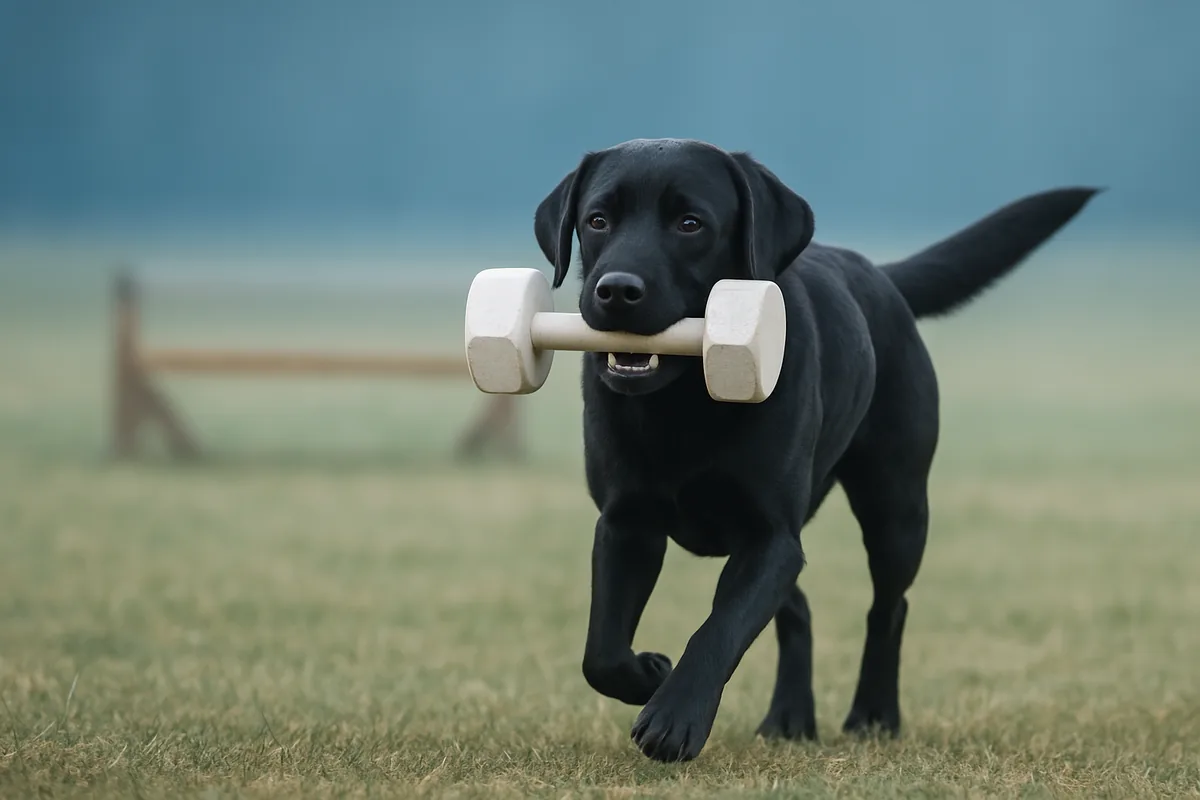
A reliable retrieve is a chain of distinct actions: the dog is sent to the dumbbell, picks it up, returns, delivers it, and finishes in the required position. Treating each action as a separate skill makes it easier to identify which actions are secure and where the sequence breaks down. Schutzhund retrieve exercises should build accuracy and a clear response to the handler’s cue, rather than relying on repeated full-length attempts. Short, successful repetitions make progress easier to measure.
Introducing the retrieve object
Teach the Schutzhund dumbbell retrieve as a sequence, but establish its component skills separately before joining them. Keep early practice brief and reward the exact behavior you want to see.
- Calm holding: Present the dumbbell at a comfortable height and reward a quiet, centered hold; increase duration only after the dog stays relaxed for several seconds.
- Carrying: Ask the dog to take a few straight steps while holding the object, then reward a steady grip without head tossing or repositioning.
- Send and pickup: Place the dumbbell nearby, send the dog on a familiar cue, and reward a prompt pickup before adding distance or a formal return.
- Return: Begin with a short recall after pickup; reward a direct path toward you, then gradually increase the distance while preserving the same cue.
- Delivery: Teach the dog to bring the dumbbell to your hands and release on cue; reward a clean handover rather than reaching for the object.
- Final position: Practice the required finish separately, such as sitting close and straight in front, then connect it to a clean delivery.
Move to the next component when the dog succeeds consistently in several short repetitions without extra prompts. Combine the steps gradually, first at close range and then across a longer send, so a complete retrieve remains clear and controlled.
Common retrieve problems
A dropped dumbbell often means the dog has not been conditioned to hold calmly through the return or while waiting for the release cue. Pause the full sequence and practice short stationary holds, rewarding a quiet grip before asking for even one step of carrying. If the dog drops as you reach forward, keep your hands still until the hold is steady and rehearse the handover as a separate task. Chewing or shifting the object can reflect an uncertain grip or repetitions that continue after concentration fades. Return to a few seconds of calm holding, reward promptly, and end that turn; do not tug the dumbbell away or repeat the entire retrieve to correct the mouth. A slow pickup is better addressed with a close, easy placement and a clear send cue. Reward a quick response there before gradually increasing the distance, rather than calling repeatedly or adding pressure. For a crooked delivery, shorten the return and reward the dog for arriving directly in front of you; practice straight approaches without the dumbbell if the path itself is unclear. Avoid moving your hands to steer the dog at the last moment, since that can make the target less consistent. Difficulty holding the final position calls for brief position practice without an object, then a separate delivery followed by the finish. If accuracy declines, reduce distance or remove one linked step and rebuild the chain. Short, reward-based Schutzhund retrieve exercises usually restore clarity faster than forcing repeated full retrieves.
Jumps and the A-Frame
Jumps and the A-frame test whether a dog can respond to the handler while moving over or across an obstacle. In Schutzhund competition obedience, accuracy and controlled movement matter more than height or speed alone. A suitable setup lets the dog approach, complete the movement, and return to the handler without struggling to find its footing. Introduce each obstacle in manageable stages and watch the dog’s movement throughout the exercise.
Fit and gradual exposure
Jumps ask the dog to clear an obstacle on cue, while the A-frame asks for a controlled climb and descent. These movements add a physical challenge to Schutzhund jumping exercises, but the aim is a fluent response rather than maximum height or speed. The obstacle should suit the dog’s build, current conditioning, and experience; a setup that makes the dog stretch awkwardly or scramble for purchase is a poor fit.
Begin with the obstacle at an easy level the dog can negotiate comfortably, then increase the challenge in small steps. For a jump, that can mean first rewarding an approach and crossing a low obstacle before asking for a more complete sequence. On the A-frame, give the dog controlled opportunities to become familiar with the route over the surface before adding distance or a faster approach. Keep early repetitions brief, with pauses between attempts, so fatigue does not blur the dog’s movement.
Comfort is visible in a steady approach, an even stride, a smooth clearance or climb, and a relaxed return to the handler. The dog should be able to take a reward and reorient without avoiding the equipment. Hesitation, repeated refusals, a shortened stride, slipping, or a change in gait are reasons to pause; if the dog appears uncomfortable, stop rather than asking for another attempt. When uncertainty is mild and no discomfort is evident, make the task easier by reducing the approach distance or returning to a familiar step. Build accuracy before adding speed, and keep the dog’s movement consistent from repetition to repetition.
Safety and equipment checks
Before Schutzhund obedience training over obstacles, inspect the training area and the equipment rather than relying on its appearance from a distance. Use this short check before each session:
- Place the obstacle on level ground and confirm that its base does not rock, shift, or tilt when touched from more than one side.
- Check that contact surfaces are dry and secure, with no loose covering, raised edge, protruding fastener, or material that moves under a firm hand.
- Clear the approach lane of leads, toys, stones, and other dogs, leaving the handler and dog a straight, unobstructed route to the obstacle.
- Keep the landing area open and free of holes, loose gravel, slick patches, and hard objects that could interfere with a balanced landing.
- Examine the frame, supports, and connections for cracks, splinters, corrosion, or loosened parts; do not use equipment with visible damage.
- Walk the route once without the dog and check that changes in light, wet ground, or nearby activity have not reduced footing or visibility.
During each attempt, watch the dog’s stride, paw placement, balance, and willingness to continue. Stop the exercise if the dog limps, slips, lands unevenly, repeatedly avoids the obstacle, or otherwise shows discomfort; do not test the same movement again in that session. Resume only when the cause is clear and the setup or task has been adjusted appropriately. A clean approach and stable equipment help the handler judge the dog’s movement accurately, so finish with controlled repetitions rather than pushing for one more jump.
Common Errors and Adjustments
Errors in Schutzhund obedience training often appear when a dog is asked to handle more complexity before the current response is dependable. A missed cue, a pause, or a change in pace can show that the exercise needs a simpler setup, not more pressure. Adjust one factor at a time so you can see what helps the dog regain clarity. Consistent handling and calm criteria make practice more productive for both dog and handler.
Rushing difficulty
Difficulty has probably increased too quickly when attention fades, the dog hesitates, movement becomes hurried, or the same error appears across several repetitions. In Schutzhund control training, adjust the exercise before asking for another full attempt.
- If the dog looks away repeatedly, reduce a single distraction, such as distance from a moving person, while keeping the familiar command and handler position.
- When the dog pauses before responding, return to a known starting position and ask for one clear, previously successful action rather than the whole sequence.
- If movement becomes rushed, shorten the sequence and reward a calm, accurate response; do not increase speed and duration in the same repetition.
- After repeated errors in a complex routine, remove one component, such as a change of direction, and practise the remaining familiar pattern.
- When a response breaks down after adding distance, return to the last distance at which the dog responded promptly and accurately.
- Progress again when several repetitions are calm and clear, with attention maintained and no repeated prompting from the handler.
Keep the session focused on one adjustment, then note whether the dog responds more readily on the next attempt. If attention or accuracy does not recover after simplifying the task, end that exercise and seek guidance from a qualified Schutzhund instructor rather than raising pressure or repeating the failed sequence.
Confusing cues
A dog can struggle with a familiar task when working dog obedience commands change from one repetition to the next. Switching a verbal cue, hand signal, cue timing, or handler position at once makes it difficult to identify what the dog is expected to follow. Choose one established word and gesture for each response, and use them in the same order; avoid adding a second command while the dog is already trying to act. If you want to refine a signal, keep the spoken cue, timing, and handler position stable while changing only that signal. Give the cue once, allow time for the response, and reset calmly if it does not happen. A brief training log can record the exact cue, gesture, position, and result, helping reveal unintended changes between sessions. Consistent marker timing also matters: mark the correct response as it occurs instead of several seconds later, when the dog may associate the reward with another action. When confusion persists despite a stable cue pattern, or the dog shows discomfort during the exercise, pause that task and ask a qualified instructor to observe the handling and response. If discomfort may reflect pain, consult a veterinarian before resuming the movement. A fixed cue set and one change at a time provide clearer feedback and more reliable communication.